
Organic Waste Recycling & Edible Food Recovery

Organic Waste Recycling Requirements: Senate Bill 1383
Under California Senate Bill 1383 (SB 1383), residents and businesses in Monterey County must properly manage organic waste to reduce landfill methane emissions while recovering edible food for people in need. Local SB 1383 programs demonstrate how regional collaboration can turn this mandate into meaningful environmental and community benefits.

Preventing Organic Waste
Residents and businesses are encouraged to reduce organic waste generation by:
- Planning meals and purchasing only what is needed
- Storing food properly to prevent spoilage
- Using leftovers creatively
- Composting food scraps as a last resort
Recycling Organic Materials
All organic waste must be separated by residents and businesses and placed in your designated organics container for collection.
Organic materials may be recycled through:

- Curbside organics collection provided by GreenWaste Recovery.
- On-site composting.
Methane Reduction Benefits
Keeping organic materials out of landfills helps:
- Prevent methane emissions that occur when organic materials decompose in landfills. Methane is a potent greenhouse gas that contributes significantly to climate change.
- Create nutrient-rich compost that improves soil health, supports local farms and landscaping, and helps build a circular local economy.
- Improve soil’s ability to retain water and store carbon, helping farms and landscapes become more resilient to drought and climate impacts.

Organic Waste Collection Services
Organic waste generated in Pebble Beach is collected by GreenWaste Recovery and processed at ReGen Monterey, your local waste management district. At ReGen, yard trimmings and food scraps are transformed into nutrient-rich compost that helps local farms grow the food that feeds our community.
Contact your hauler if your home or business does not yet have an organics cart.
Public Health and Environmental Benefits
Diverting organic waste from landfills helps protect public health and the environment by:
- Reducing methane emissions that contribute to climate change
- Protecting air and water quality
- Conserving landfill space for future generations
Recover Edible Food: Help Families in Need While Reducing Waste

Edible Food Recovery (EFR) is part of the implementation of California's Senate Bill 1383, addressing climate pollutants and wasted food. Each year, Californians send 2.5 billion meals worth of still-fresh, unsold food to landfills while 1 in 5 California residents do not have enough to eat. In the Monterey County Health Needs Collaborative 2022 report, more than 40% of Monterey County community members were determined to be food insecure. To reduce food waste and address food insecurity, SB 1383 requires California to recover 20% of edible food that would otherwise be discarded by 2025 and redistribute it to people in need. This goal is supported through edible food recovery, which redirects surplus, safe-to-eat food from businesses to local Food Recovery Organizations (FROs). ReGen Monterey has resources that can connect food generating businesses with nonprofits that distribute food to residents in need including food pantries, senior meal delivery programs, homeless service providers, campus food hubs and food banks.
Which businesses are required to donate edible food?
CalRecycle requires Tier I and Tier II commercial edible food generators to donate edible food to food recovery organizations.
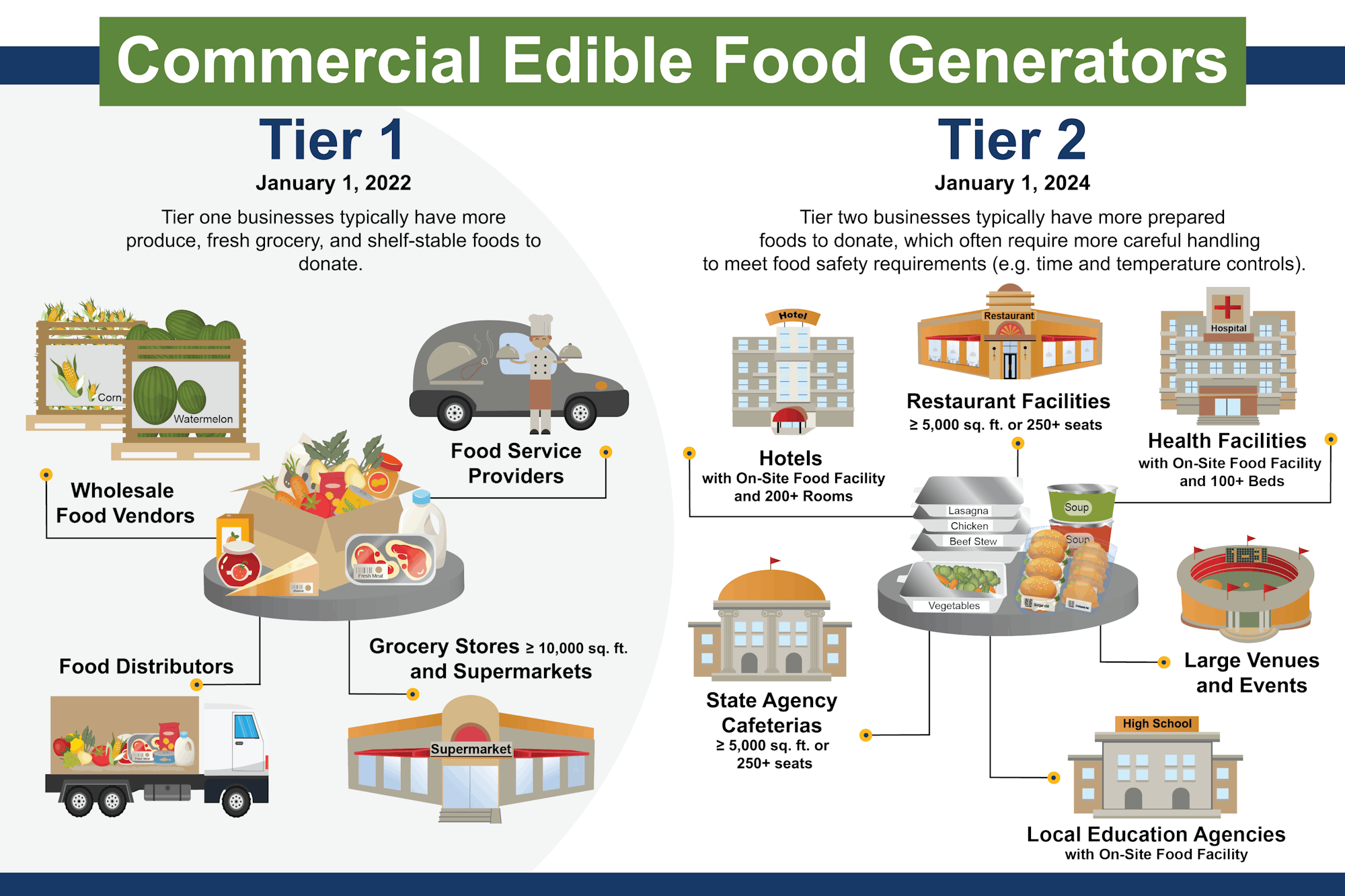
Edible Food Recovery Organizations Available to Receive Donations from Pebble Beach Commercial Food Generators
-
Al & Friends
- 301 Cypress Ave., Pacific Grove, CA 93950
- (831) 402-0820
- alvinsiekert@gmail.com
-
Meals on Wheels of the Monterey Peninsula
- 700 Jewell Ave., Pacific Grove, CA 93950
- (831) 375-4454
- ehobbs@mowmp.org
-
Shoreline Church Food Pantry
- 2500 Garden Road, Monterey, CA 93940
- (831) 277-9661
- sharon@shoreline.church.org
-
Salvation Army Sand City
- 800 Scott St., Sand City, CA 93955
- (831) 899-4911
- Jenifer.Miller@usw.salvationarmy.org
How to Donate Food
- The Safe Surplus Food Donation Toolkit was created for use and distribution by Environmental Health Departments across California to educate food facilities about safe surplus food donation. The toolkit includes information on liability protections, state mandates, and safe surplus food donation practices.
- Edible food generators can donate surplus food through the Careit app or website. Creating an account is free and allows donors to connect with local food recovery organizations. The platform also helps track donations by food type and amount, making compliance and reporting easier.
- Visit the list of local edible food recovery organizations for a peninsula-wide list of organizations currently accepting food donations.
- Learn more about Edible Food Recovery Grants.
- Visit CalRecycle to learn more SB 1383 requirements for food recovery organizations.
- Best Practice Guide for Food Recovery Organizations and Services.
For more information on this topic, please visit the CalRecycle Website or review the CalRecycle Edible Food Recovery FAQS.